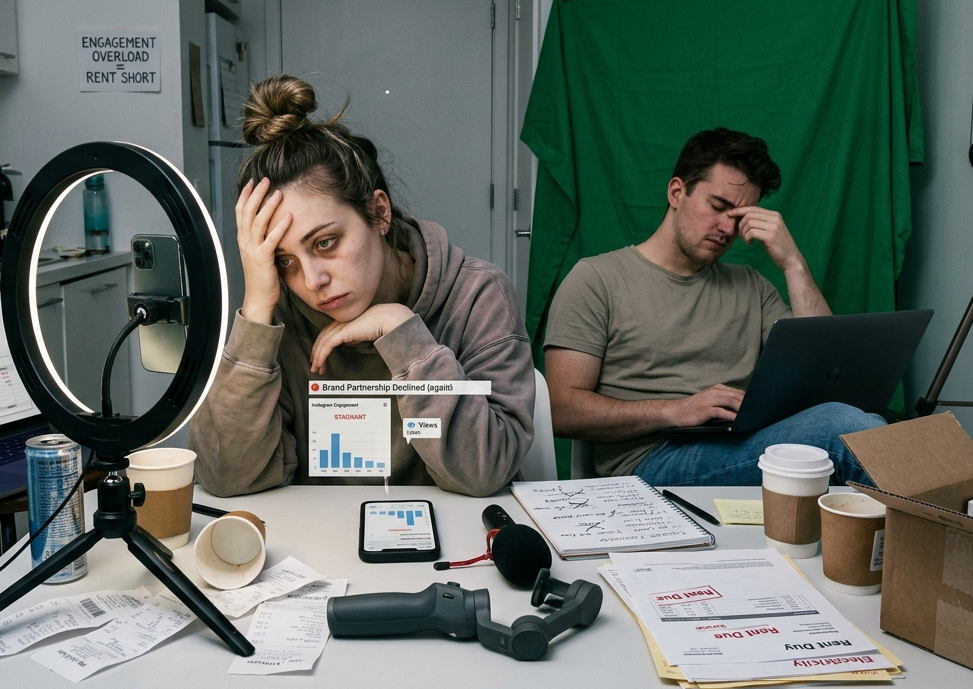
8.7 million creators now earn over $1,000 a month. The platforms want to automate exactly the thing that got them there.
Something unusual is happening in the creator economy, and it's getting buried under the AI hype cycle. There are now 8.7 million creators worldwide earning more than $1,000 a month. That's up from 2.2 million in 2024. A genuine middle class — people building genuinely sustainable businesses from their audiences — has materialized. The creator economy is now valued at $234 billion. U.S. creator ad spend alone is tracking toward $44 billion this year, growing 18% year over year.
By every measure, the industry is maturing. More money, more people, more stability.
And the platforms are about to make the thing that built it harder to sustain.
What Made the MicroInfluencers
The rise of the creator middle class isn't a content story. It's a diversification story.
Creators earning $3K–$10K/month — the beating heart of this new middle — aren't getting there on platform ad revenue alone. The ones building durable income have three or more revenue streams: ad revenue, brand deals, memberships, digital products, affiliate income. Creators with three+ revenue streams earned an average of $75,000 more annually in 2025 than those relying on a single source. That's not a rounding error. That's a business model.
The structural shift is real: the creator who treats their audience as a product to be sold to advertisers is the creator who's one algorithm change from a 40% income drop. The creator who treats their audience as a relationship to be deepened — and monetizes that relationship directly — is building something with actual defensibility.
73% of creators who implemented tiered (affordable) memberships reported increased financial stability. That's not a coincidence, that's the architecture of a business that doesn't evaporate when Instagram tweaks its Reels payout formula (read my last blog on THAT).
A Trust Paradox
84% of creators now use generative AI tools — the rest are apparently sabotaging data centers, not unlike throughout history when men sabotaged cars so their horse business didn't fail. You'll never extinguish the human spirit to build — it's in our DNA — but that's another blog for another day. The platforms are flooded with AI-assisted content — faster, cheaper, more consistent, and increasingly indistinguishable from human-made work. The output volume has exploded. Audience trust has not kept up on schedule according to the well-documented technology adoption play book.
Consumer preference data is unambiguous: people want human-created content. The trust premium for authentic, identifiable human creative work has never been higher. YouTube is explicitly deprioritizing “inauthentic content” and adding quality reviews to its partner program specifically targeting AI-assisted, faceless, and compilation channels. Instagram is rewarding “authentic engagement over sheer follower count.” The platforms built on creator-audience relationships are watching their core value proposition erode from within — and they're responding with policies that, ironically, make it harder to reach the audience you already built.
This is the trust paradox: the tool that lets you create more efficiently is also the tool that's degrading the thing your audience actually pays for. The answer is NOT “use AI less.” The creators who thrive in this environment will use AI as infrastructure — for research, scheduling, distribution, analytics — while doubling down on the part that can't be automated: a specific point of view, a genuine relationship with an audience, the kind of trust that compounds over years.
The creators who don't understand that distinction are building their businesses on sand.
Eligibility Arithmetic
Meanwhile, the platforms are raising the bar and will continue to do so. YouTube's partner program now includes a quality review layer targeting channels without a clear “creator identity.” TikTok's Creator Rewards Program requires 10,000 followers and 100,000 views in the last 30 days — a threshold that cuts out the emerging creator before they've had time to build momentum. Instagram killed the Reels Play Bonus and replaced it with Ads Revenue Sharing that requires 50,000+ Reels views per week to activate meaningfully.
Every one of these changes has the same structural effect: they defer the moment a creator starts earning, and compress the window in which a creator can diversify before they've built enough audience to survive a platform policy shift.
The creator who doesn't understand their own numbers — what content drives what revenue, which platform is actually converting their audience, what's working across the space for people like them — is making every important business decision in the dark.
This is the intelligence gap. And it's widening.
What Does Data Enable
The middle class didn't emerge because creators got better at content. It emerged because a critical mass of creators started making better decisions — understanding their audiences, diversifying their revenue, building relationships that survived platform volatility.
The next wave of creators who break through to sustained income will be the ones with access to real intelligence: not just their own performance data in isolation, but what's working across thousands of creators in their niche, on their platforms, with their audience size. The difference between guessing and knowing isn't just efficiency — it's survivability. The trust paradox is actually an opportunity. When authenticity is scarce and audiences are more discerning than ever, the creators who can identify exactly what their audience responds to — and why — have a structural advantage over everyone else producing volume.
The MicroInfluencer — or middle class if you will — is real. Keeping it real requires knowing what you're actually building.
Tonimus is building the data layer that gives creators the intelligence to understand exactly what's working — not just for them, but across the whole landscape. We're in private beta — apply for early access.